Fulham House Clearance Health & Safety Policy
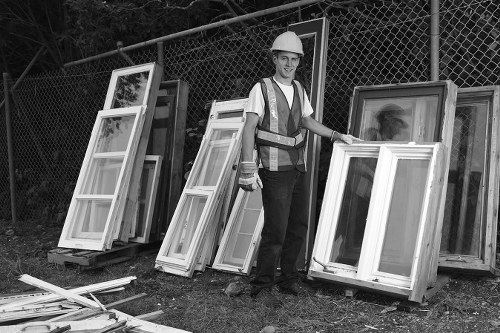 This Health and Safety policy sets out the responsibilities and procedures for Fulham House Clearance as a professional rubbish company operating a rubbish removal and house clearance service area. The aim is to protect staff, clients, contractors and the public while delivering efficient waste removal and rubbish clearance services. Safety is integral to every job, from initial assessment to final disposal, and this document explains the systems in place, hazard controls, and our commitment to continuous improvement.
All employees must understand their duties under this policy. Supervisors will ensure that risk assessments are completed for each job, and that safe systems of work are documented. Personal protective equipment (PPE) such as gloves, eye protection and high-visibility clothing is mandatory where appropriate. Training in manual handling and safe lifting techniques is provided to minimise musculoskeletal injuries during bulky item removal and junk removal tasks. Reporting of incidents or near misses is required immediately so corrective actions can be taken.
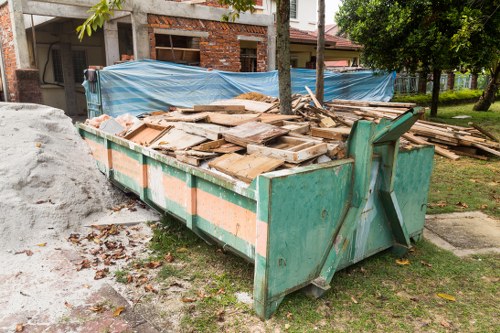 The company maintains an emergency response plan for accidents, hazardous material discovery, vehicle incidents and adverse weather that could affect waste collection operations. Our health and safety rules include a clear permit-to-work process for complex removals and a lockout approach for any electrical or gas-powered items. Key controls include:
- Pre-job risk assessment that identifies hazards and control measures
- Safe access and egress to properties and removal points
- Waste segregation and handling protocols to reduce contamination risks
Drivers and crew are trained in vehicle safety and secure loading practices to prevent shifting loads during transit. Regular vehicle checks are scheduled and recorded, covering brakes, lights and load restraints. For domestic and commercial clearances, traffic management and pedestrian protection measures are used where necessary. Our waste carrier responsibilities include correct classification of items and prioritising reuse and recycling over disposal when possible to reduce environmental risk associated with landfill and incineration.
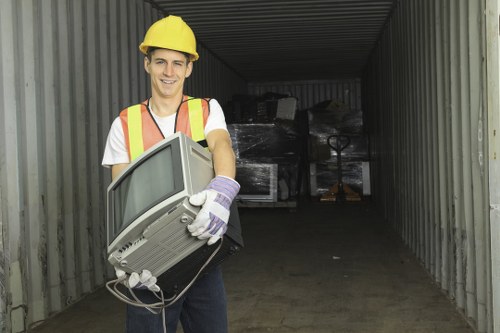 Contractors and subcontractors engaged for specialist removals must provide evidence of competency and operate under equivalent health and safety standards. Chemical or biological hazards encountered during house clearance — such as asbestos, syringes or contaminated waste — are handled only by trained personnel or referred to licensed removal specialists. The company maintains an incident log and carries out investigations to identify root causes and prevent recurrence, with outcomes recorded and shared for learning.
Household hazardous waste is separated and stored in clearly labelled containers until it can be lawfully disposed of. Staff are trained to recognise household, garden and builder’s waste categories and to comply with waste transfer documentation requirements. We encourage staff to adopt a safety-first mindset and to refuse work that cannot be completed safely without additional controls or equipment. Regular toolbox talks and practical demonstrations maintain awareness of safe practices for everyday rubbish clearance tasks.
Risk Management and Responsibilities
Managers are responsible for carrying out documented risk assessments and ensuring that all controls are implemented. Employees are required to follow procedures, use PPE and report deficiencies. Our waste removal service area uses a hierarchy of controls: eliminate, substitute, engineer, administrate and PPE. The policy emphasises collaboration between team members, clients and third-party suppliers to ensure safe completion of each clearance. Continuous monitoring and periodic review of procedures ensures compliance with evolving safety standards and operational lessons learned.
Training includes manual handling, hazardous materials awareness, vehicle operations and first aid preparedness. A first aid kit is available on all service vehicles and staff are encouraged to maintain valid first aid competencies. Where mechanical lifting equipment is used, only trained operators will handle such tools and pre-use checks are mandatory. Inspections and maintenance of lifting aids and trolleys are recorded to ensure equipment remains serviceable and safe for every removal job.
Monitoring, Review and Reporting
Regular audits of site procedures, vehicle records and incident logs are undertaken to verify compliance. Performance indicators such as incident rates, near-miss frequency and training completion levels are reviewed by management. Corrective actions are tracked until closure. Employees are invited to contribute to safety reviews and to suggest improvements that may enhance safe working during bulky waste clearances and domestic removals. This policy will be reviewed at least annually, or after significant incidents, changes in legislation, or alterations to operational activities. It is the responsibility of management to communicate updates and to ensure that staff are made aware of any procedural changes. By embedding safety into daily routines, Fulham House Clearance commits to delivering reliable rubbish collection, clearance and waste removal services while protecting people and the environment through practical, enforceable safety measures.
Conclusion: The policy defines clear roles, consistent standards and an expectation of safe behaviour across all jobs. Adherence to these principles supports efficient rubbish removal operations and reduces risk exposure for employees, clients and the wider community. Commitment to training, supervision and continuous improvement underpins our approach to safe house and garden clearance, junk removal and sustainable waste management.
Signed and endorsed by company management as the governing statement of health and safety intent. Regular communication, documented procedures and responsible operational control will ensure that our waste clearance activities are completed safely, professionally and with due regard to health, safety and environmental protection.